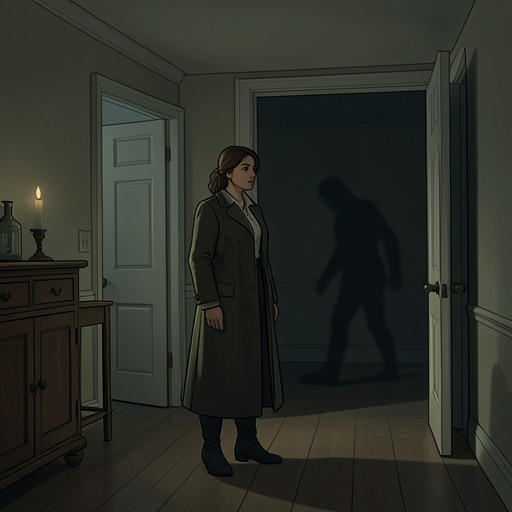
Jessica sells Kayla's paintings
Call Me YoursJessica sells Kayla's paintings through a discreet, years-long arrangement with Taylor Gonzalez, turning her position as Kayla's assistant into the means of a larger theft, embezzlement, and murder conspiracy. What appears to be the private circulation of valuable art is in fact a decisive shift in the story: Kayla's collection becomes both the evidence of Jessica's betrayal and the financial instrument Jessica hopes will secure a new life.
The Scheme and Its Setting
Jessica conducts the sale away from home, at Joe's steakhouse, a small restaurant thirty miles from her house. The distance is deliberate: she chooses the location because she is unlikely to encounter anyone who knows her. There she meets Taylor Gonzalez, a petite, bespectacled man in his fifties, who greets her familiarly and shares a booth with her. His discretion makes the meeting possible; he has bought Kayla's paintings from Jessica for years, asked no questions, and paid what Jessica considered a reasonable price.
The transaction is therefore not an isolated act of desperation. Jessica arrives with an established buyer and a practiced method. When Taylor asks what she has brought him, she identifies the goods as a collection of original paintings and says that she can deliver them the next day. She asks when she will receive the money, and Taylor answers that the transfer will take less than twenty-four hours. The speed and routine of the exchange show how completely the theft has been incorporated into Jessica's ordinary activities.
Kayla's Wealth as Target and Commodity
The paintings belong to Kayla Renae Morrison, a business tycoon and socialite whose wealth is displayed through both art and luxury. At Vanessa Lauren Art Gallery, Kayla purchases a historical painting worth fifty-five million dollars, and the gallery's policy is to deliver purchased paintings the following morning. Her collection is not ornamental in any narrow sense: it represents a fortune capable of being moved, concealed, sold, and converted into cash.
Kayla's residence, Morrison Villa, reinforces the scale of the opportunity. The cream-colored mansion occupies 1.5 acres and includes a multi-car garage, a spa, a gym, a tennis court, a lake with Kayla's yacht, and staff quarters near the garden. Inside, chandeliers, gold-painted walls, a marbled floor, burgundy drapes, and a French portrait of Kayla establish an environment in which exceptional objects are part of daily life. Jessica's access to that environment gives her proximity to possessions whose value is far beyond ordinary scrutiny.
Kayla understands that her wealth distorts intimate relationships. In a letter to Chris Davis, she explains that she placed a newspaper advertisement because men who learned how much she was worth professed love for what they could obtain from her. She describes herself as one of the richest women in the world, the owner of Morrison Group of Hotels, and a member of a wealthy family. Her paintings belong to the same economy of value that makes her vulnerable to opportunists: they are signs of status, stores of capital, and tempting instruments for anyone seeking control over her property.
From Art Theft to a Larger Conspiracy
The sale's most serious consequence appears in Jessica's intended use of the proceeds. After the money is transferred to her account, she plans to get rid of Kayla and Chris with help from Dr. Reid Francois. She imagines that, once they have been dealt with, she and Jamie Cooper will have a better life. She also expects that winning Adi Morrison over may take time, but resolves to make the effort. Thus the paintings are not merely stolen goods; they are part of Jessica's imagined escape from her failing marriage and her route toward control of Kayla's family and estate.
Jessica's ambition is made explicit in a notebook discovered by Jamie. Behind a wardrobe door, he finds a secret study containing a small oak desk, a reading lamp, and notebooks. In the last notebook he reads the written plan to get rid of Kayla, take her money and properties, and change the deeds into Jessica's name. The sale at Joe's steakhouse supplies the cash side of that plan, while the notebook records its legal and material objective: the transformation of theft into ownership.
The conspiracy also depends on intimidation. Don tells Jessica that Kayla owns chains of hotels, a mansion, and properties in wealthy neighborhoods and that she is a billionaire. When Jessica offers him one million dollars to leave them alone, Don rejects the offer because he expects to receive twice that amount after Kayla is dead. His calculation exposes the scale of the fortune Jessica is trying to appropriate and shows how the paintings connect her private betrayal to a wider network of coercion and violence.
Contrast with Jessica's Other Conduct
The art sales stand in sharp contrast to Jessica's stated position as Kayla's assistant and to the domestic trust surrounding her. Kayla's household is organized around service, access, and confidence: when Kayla returns to Morrison Villa, butlers bow, maids hurry into the kitchen, and security guards salute her. Jessica moves within this protected environment while secretly removing valuable property from it. The more secure and extravagant the household appears, the more profound Jessica's breach becomes.
Her conduct also contrasts with the visible conflicts inside Kayla's family. Adi Morrison is a rebellious teenager who spends time on her laptop, wears a black beanie, and resents Jessica's attempts to lecture her or act like her mother. Later, Adi's effort to appear older allows her to enter clubs and bribe bouncers, leading her into an alley with Jimmy, a gangly gothic boy who tries to isolate her. These episodes place young people's struggles over autonomy beside Jessica's adult struggle for wealth and control. Adi's rebellion seeks freedom from imposed identities, whereas Jessica's theft seeks to impose a new identity on Kayla's property.
The deeper family secret makes the sales still more consequential. Jessica eventually reveals to Kayla that Jamie has an alter ego named Kayla Renae Morrison, that Kayla is wealthy and owns hotel chains and a mansion, and that Jessica discovered this while she was pregnant with Adi. She says that Kayla accepted Adi as her own without remembering that Adi was Jessica's child. Against this background, the stolen paintings are bound not only to financial greed but also to concealed parentage, unstable identity, and Jessica's attempt to reorganize the family around her own interests.
Narrative Significance and Aftermath
Jessica's sales mark the conversion of hidden access into actionable power. The paintings begin as protected works in Kayla's collection, pass through Jessica's unauthorized possession, and become promised cash in Taylor's hands. Each transfer strips Kayla of security while increasing Jessica's capacity to act. The event's value shift is therefore from apparent prosperity to threatened dispossession: Kayla's wealth, which might have enabled love, comfort, and protection, becomes the very resource that attracts betrayal and enables the conspiracy against her.
The scene also turns objects into witnesses. Taylor's repeated purchases, the promised transfer within twenty-four hours, and Jessica's written instruction to take Kayla's money and properties establish a pattern rather than a single unexplained disappearance. Jamie's discovery of the notebook gives the theft a documentary counterpart, while the later revelation of Jessica's family knowledge places the art scheme inside a much larger history of secrecy. By the time the plan to remove Kayla and Chris is stated openly, the paintings have already shown how the conspiracy operates: quietly, through trust, access, resale, and the conversion of another person's life into an inventory of saleable assets.